
Restaurant Equipment Maintenance
The holidays push a commercial kitchen harder than any other stretch of the year: more product in the walk-in, more door openings, more hot food to cool, and more ice going out the door. In the Phoenix Metro, that surge arrives just as many hotels and restaurants head into their busiest months, which run from fall through spring. Refrigeration that held temperature all summer can struggle under a full holiday load, and a failure in the middle of a rush costs far more than a service visit in early November. This guide covers what to check, how to load your coolers safely, and what to repair now so Thanksgiving week does not become the week your walk-in quits.
Key Takeaways
- Do a pre-season check now: temperature accuracy, gaskets, door closure, coils, drains, and ice machine output. Early November leaves time to repair and reorder parts before Thanksgiving week.
- Holiday volume is a loading problem as much as an equipment problem. Overfilled coolers block airflow and run warm, so plan the space before the product arrives.
- Cooling large batches of hot food is where holiday kitchens get into trouble. The FDA Food Code expects cooked food to cool from 135°F to 70°F within two hours and to 41°F or below within six hours total.
- Verify temperatures with a calibrated thermometer, not just the controller display, and log them. Cold-held food belongs at 41°F or below.
- Decide your backup plan before you need it: who to call, where product goes, and what you can save if a box fails.
Why the Holidays Are Hard on Refrigeration
Holiday service changes how your refrigeration is used, and every change adds load:
- Fuller boxes. Bigger deliveries and extra prep for catering and events put more product in the walk-in than a normal week does.
- More door openings. More staff pulling more product means warm air enters more often and the door stays open longer.
- Hot food to cool. Large batches of cooked food have to come down to safe temperatures inside your coolers.
- More ice. Banquets, bars, and buffets draw far more from the ice machine than an ordinary dinner service.
Phoenix’s cooler weather takes some heat off outdoor condensers compared with summer, but it does nothing about door traffic, product volume, or a crowded box. A unit that is already running close to its limit has no margin when the rush arrives.
Two to Three Weeks Before the Rush: A Pre-Season Check
Early November leaves time to find a problem, order a part, and finish the repair before Thanksgiving week. Walk the kitchen with this list and have a technician look at anything that does not pass.
| Equipment | What to check | Why it matters |
|---|---|---|
| Walk-in cooler and freezer | Read temperatures with a calibrated thermometer, inspect door gaskets, hinges, and closers, look for ice on the evaporator, and confirm drain lines are clear | Air leaks and drift show up first as warm spots and frost, and they get worse under a full load. See our gasket replacement guide. |
| Reach-ins and prep tables | Check temperatures at the door side and the back, clean condenser coils and filters, and test door seals | Dirty coils and worn seals force longer run times and warmer product. |
| Condensers and coils | Clean coils, clear debris, and confirm clearance for airflow | Restricted airflow raises head pressure and makes the compressor work harder. |
| Ice machines | Compare production to your busiest day, clean and sanitize per the manufacturer, replace the water filter if it is due, and inspect the bin | A machine that barely keeps up on a normal night will not keep up at a banquet. See why an ice machine stops making ice. |
| Thermometers and alarms | Calibrate probes, replace batteries, and test any alarm or monitor | A wrong reading is worse than none. Our temperature monitoring guide covers continuous alerts. |
Plan Your Cooler Space Before the Product Arrives
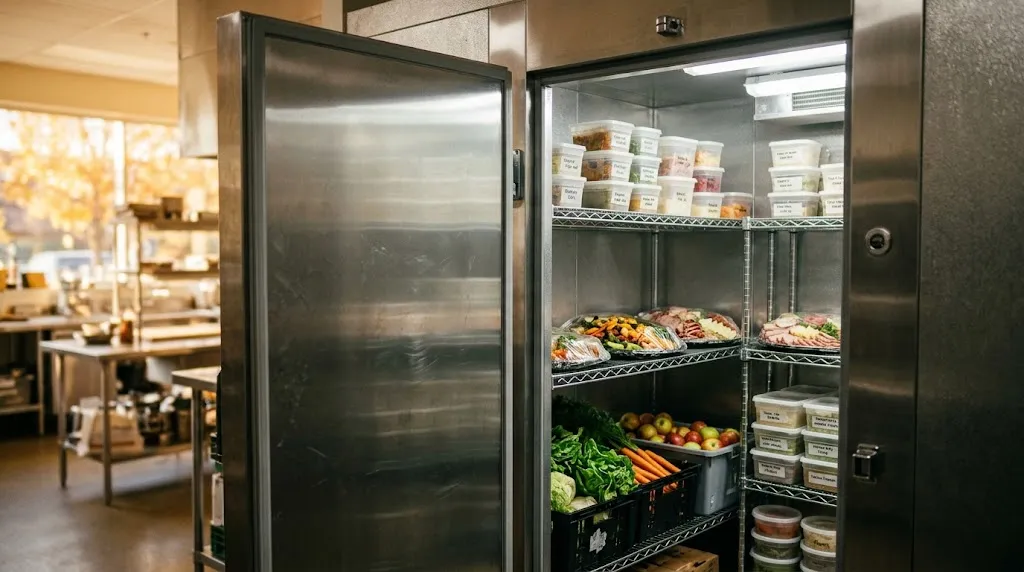
A walk-in holds temperature by moving air. The evaporator fans pull warm air through the coil and push cold air back through the box, so anything that blocks that path creates warm pockets. Overfilling is one of the most common ways a healthy walk-in ends up running warm.
- Leave clear space around the evaporator fans and never stack product against them.
- Keep product on shelving and off the floor, and keep the area just inside the door clear.
- Stagger deliveries and load in batches, with the door closed between trips.
- Keep frequently used items in reach-ins near the line to cut walk-in door openings.
- Label and date everything and rotate first in, first out, so staff can find product without holding the door open.
If the math does not work, meaning you cannot hold your holiday volume at safe temperatures, solve it before the rush with earlier delivery windows or temporary cold storage instead of cramming the box.
Cooling Hot Food Without Overloading the Walk-In
Under the FDA Food Code, cooked food that needs time and temperature control must cool from 135°F to 70°F within two hours, and from 70°F to 41°F or below within a total of six hours. Editions of the Food Code differ and local rules build on them, so confirm what Maricopa County expects and follow your inspector’s guidance.
A large, hot stockpot set in the walk-in is one of the fastest ways to warm everything around it. Cool in a way that helps the box instead of fighting it.
Cooling checklist for holiday batches
- Divide large batches into shallow pans so heat escapes quickly.
- Use ice baths, ice paddles, or a blast chiller to speed the first stage before the food goes into the box.
- Do not stack pans or cover them tightly until the food has cooled.
- Probe the food and record the time and temperature at each checkpoint.
- If a batch misses a checkpoint, follow your food-safety plan and ask your health department what corrective action applies.
Cooling logs also help in an inspection, because they show your process works.
Verify Temperatures, Then Keep Records
Cold-held food belongs at 41°F or below, and a freezer should hold 0°F or below. The number on the controller is only a starting point, because displays can drift out of calibration. Check the display against a calibrated thermometer placed where the product sits, and log the reading at the same times every day. Our walk-in temperature guide explains where to place the thermometer and what to do when a box runs warm.
Signs to Repair Now, Not After the Holidays
Warning signs that should not wait
- A cooler that creeps above 41°F or swings widely during the day.
- A compressor or condenser fan that runs constantly or cycles on and off rapidly.
- Ice or frost on the evaporator, the coil, or the door frame.
- Door gaskets that are torn, hardened, or leave visible gaps, or a door that no longer closes on its own.
- Water pooling near the unit or a blocked drain line.
- An ice machine that slows down, stops, or makes cloudy or thin ice.
A box that barely holds temperature on a light day will not hold it on your heaviest day.
Book a pre-season check now and there is time to order parts before Thanksgiving week. Ice Age Commercial offers same-day service based on availability.
Have a Backup Plan Before You Need One
- Post your service number where every manager can find it, and keep it with your power-outage plan.
- Decide in advance where product goes if a box fails: a second cooler, rented cold storage, or insulated containers with ice.
- Keep a current list of what is in each box so you can move the most perishable items first.
- Keep extra calibrated thermometers and a supply of ice on hand, and keep the door closed while you work.
Our monsoon power-outage plan covers the same steps for outages, and most of it applies to an equipment failure too.
For Hotels, Caterers, and Bars
- Hotels and resorts: banquet and event days multiply ice and cold-storage demand, so test ice machines and walk-ins against your largest booked event.
- Caterers: pre-chill transport coolers and vehicles, and verify product temperature at loading and on arrival.
- Bars and restaurants: check beverage coolers, glass chillers, and ice bins, because they work hardest on the busiest nights.
Our walk-in cooler and freezer repair, ice machine repair, and commercial refrigeration repair services cover every piece of equipment on this list.
Frequently Asked Questions
How early should I schedule a pre-holiday refrigeration check?
Ideally two to three weeks before your busiest week, so there is time to order parts and finish repairs. For Thanksgiving, that means early November.
What temperature should my walk-in hold during the holidays?
The same as any other time: 41°F or below for cold-held food and 0°F or below for a freezer. Many operators set the cooler a few degrees under 41°F for margin. A heavier load makes that margin harder to keep, which is why the checks matter.
Can I put hot food straight into the walk-in?
Not in large batches. A big hot pan warms the food around it and loads the system. Divide the food into shallow pans and speed the first stage of cooling with ice or a blast chiller, then follow the Food Code cooling steps.
What should I do if my walk-in fails during service?
Keep the door closed, move the most perishable product to working cold storage first, check product temperatures, and call your service company. Evaluate anything that warmed above 41°F under your food-safety plan and local code.
Written and reviewed by Ice Age Commercial. We repair and maintain refrigeration, ice machines, dishwashers, and cooking equipment across Tempe and the Phoenix Metro Area. Always defer to your manufacturer’s manuals and your local code.
Get Your Refrigeration Ready Before the Rush
Ice Age Commercial repairs and services commercial refrigeration and ice machines for restaurants, hotels, caterers, and grocers across Tempe and the Phoenix Metro Area. Same-day service is available based on availability.