Commercial Kitchen Repair
A commercial ice machine not making ice usually comes down to one of five things: the water supply, a dirty condenser that has triggered a high-pressure shutdown, scale in the water system, a false bin-full signal, or a failed component such as a water valve or sensor. The first four you can check yourself in a few minutes. The last one, and anything involving the refrigeration circuit, needs a technician. This guide walks through the checks in the order that saves the most time, so you know when to fix it yourself and when to call.
Key Takeaways
- Check the simple things first: power and switch position, a closed or restricted water supply, a clogged inlet screen or filter, and a bin that is not actually full.
- On air-cooled machines, a dirty condenser or blocked airflow can open the high-pressure cut-out and shut the machine down, and heat makes it worse.
- A machine has four systems (refrigeration, water, harvest, and electrical control), and a fault in any one of them stops ice production.
- Scale from hard water can foul sensors and water flow. A water softener is usually not the answer, according to Scotsman’s own guidance.
- Refrigerant work is not a DIY job. Federal law requires EPA certification to handle refrigerant, so leave the sealed system to a qualified technician.
Start Here: Five Checks Before You Call Anyone
Most “no ice” calls end at one of these checks. Work through them in order, and write down what you find so a technician can use it if you do need to call.
Five-minute checklist
Confirm the machine has power and the switch is in the ice-making position, not off or clean.
Look in the bin. Ice bridged up against the bin sensor, or a full bin, tells the machine to stop on purpose.
Make sure the water service valve is open, the line is not kinked, and the filter cartridge is not restricted.
On air-cooled models, check that the condenser is clean and that nothing blocks the airflow around the machine.
Check for indicator lights or alarm codes, write them down, and then try one reset following your manual.
If the machine restarts and makes ice, the cause was one of these. If it stops again, keep reading to narrow it down.
Match What You See to the Likely Cause
The way the machine fails points to the system at fault. Use the table to decide whether it is a check you can make or a repair to schedule.
| What you see | Likely cause | Who handles it |
|---|---|---|
| No water entering the machine | Closed supply valve, clogged inlet screen or filter, failed water inlet valve | You for the valve, screen, and filter. Technician for a failed valve. |
| Water runs but no ice forms | Refrigeration problem, dirty condenser, or a control or sensor fault | Clean the condenser yourself. Technician for the rest. |
| Machine stops after running briefly | High-pressure cut-out from a dirty condenser or poor airflow | Clean the condenser first. Technician if it repeats. |
| Bin is empty but the machine is idle | False bin-full signal from a bridged ice or a sensor fault | You for clearing ice. Technician for a failed sensor. |
| Small, thin, or slow-forming ice | Scale or restricted water flow, warm incoming water, hot surroundings | Descale and check the filter. Technician if it continues. |
| Ice forms but will not release | Harvest-system problem or a control fault | Technician |
| No lights, no response at all | No power, tripped breaker, failed control board or contactor | You for the breaker. Technician for the rest. |
Water Supply and Scale Problems
Manufacturer service guidance repeats the same water-side fixes: open the water service valve if it was closed, clean a dirty inlet screen, and replace restricted filter cartridges. A machine that cannot fill its reservoir cannot make ice, and a partially restricted line often produces weak, thin ice before it produces none at all.
Scale is the slower version of the same problem. All water carries some dissolved minerals. The City of Phoenix explains that calcium and magnesium picked up from the soils its source water passes through contribute to hardness, and scale is a common maintenance concern for ice machines across the Valley. As cubes freeze, the water left in the sump becomes a concentrated mineral solution, and the minerals deposit on water distribution parts, sensors, and probes. A fouled sensor can tell the control board something that is not true, which stops production.
Many owners reach for a softener. Scotsman’s application bulletin says softened water is usually not an improvement over hard water for an ice machine, because softening replaces calcium and magnesium with sodium and does not reduce the mineral content. Scotsman does not recommend a softener as the only form of treatment. Filtration matched to your water, plus regular descaling on the manufacturer’s schedule, does more.
Heat, Dirt, and the High-Pressure Shutdown
Air-cooled machines depend on airflow across the condenser. Service guidance is consistent here: keep the condenser clean and the airflow clear, because the higher the surrounding temperature, the less ice a machine will produce. On air-cooled models, a dirty condenser can drive pressure up until the high-pressure cut-out opens and stops the machine. Cleaning the condenser and resetting the cut-out is a standard fix, but if it trips again, something else is wrong and a technician should check operating pressures.
Phoenix makes this a seasonal issue. Dust collects on condensers, kitchens run hot, and machines in tight back-of-house spaces recirculate their own warm exhaust air. If your machine slows down every summer afternoon and recovers overnight, look at the airflow and the condenser before you suspect a failed part. If a walk-in or reach-in is also struggling in the heat, our commercial refrigerator not-cooling guide covers the same airflow and condenser checks.
False Bin-Full Signals
The machine stops making ice when it believes the bin is full. That signal can come from a sensor near the evaporator or a thermistor in the bin. If ice has bridged across the sensor, or if scale or a failing sensor is sending the wrong reading, the machine shuts off with an empty bin. Clearing the ice and checking the sensor area for debris or scale solves some cases. If the machine keeps shutting off with plenty of room in the bin, the control or sensor likely needs replacement.
Machine still down after the basic checks? Ice Age Commercial can diagnose the water, refrigeration, harvest, and control systems and get your ice back.
The Four Systems That Make Ice
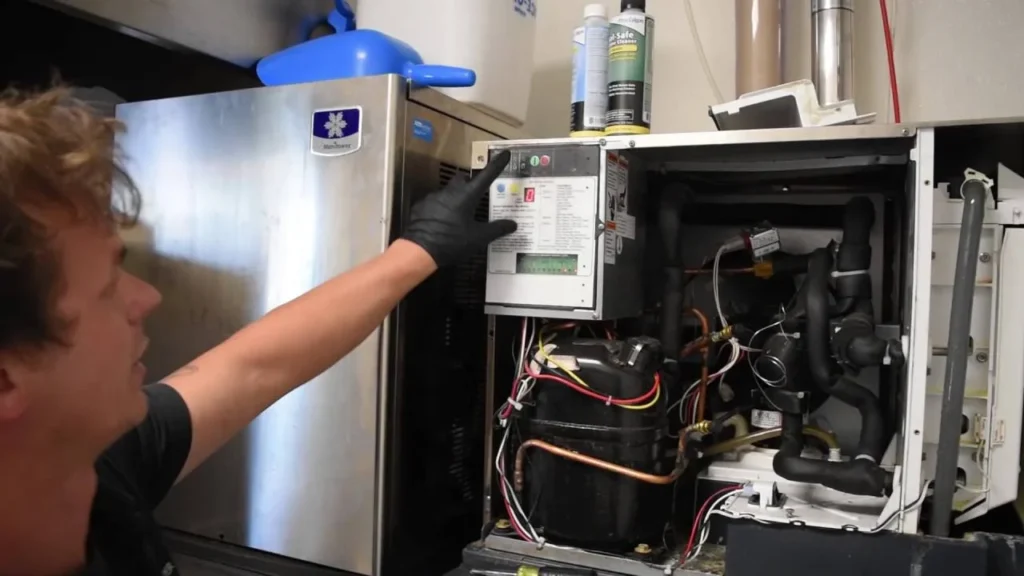
Technicians troubleshoot commercial ice machines by system, because a fault in any one stops production:
- Refrigeration: the compressor, condenser, evaporator, and refrigerant circuit that create the cold.
- Water: the inlet valve, filter, reservoir, pump, and distribution parts that supply and circulate water.
- Harvest: the process that warms the evaporator just enough to release the ice into the bin.
- Electrical control: the control board, sensors, thermistors, and contactors that sequence everything.
You can reach the surface of the water side and the condenser. Everything else is the technician’s territory. Refrigerant in particular is regulated, and handling it legally requires EPA certification, so a suspected leak, a compressor that will not start, or a machine that runs but never freezes belongs with a qualified technician. Our explainer on the 2026 EPA refrigerant rules covers what that means for your equipment.
What Not to Do
- Do not keep power cycling. Repeated resets can hide the pattern a technician needs to see. Reset once, note the result, and call if it fails.
- Do not run the machine dry or with a closed water supply. Fix the water issue first.
- Do not use the bin to store food or drinks. It blocks airflow and contaminates ice that is meant to be served.
- Do not bypass a safety control to force it to run. A tripped cut-out is protecting the compressor.
- Do not serve ice that melted or looks contaminated. After a long outage, clean and sanitize the bin before you restart.
Keeping It From Happening Again
Most no-ice calls are preventable. Clean the condenser and air filter on a schedule, replace the water filter by its rating, descale and sanitize on the interval in your manual, and keep clearance around the machine. A preventive maintenance plan puts those tasks on a calendar so they do not slip. For a wider look at kitchen equipment faults, see our commercial kitchen troubleshooting guide.
When a repair is needed, Ice Age Commercial offers same-day service based on availability across Tempe and the Phoenix Metro Area. Learn more about our ice machine repair service.
Frequently Asked Questions
Why is my ice machine running but not making ice?
When the machine runs but produces no ice, look at the water supply first, then the condenser and airflow. If the water is flowing and the condenser is clean, the problem is usually in the refrigeration circuit, the harvest system, or a sensor, and a technician should diagnose it.
How long should I wait after a reset before I expect ice?
It depends on the model. Allow at least one full freeze and harvest cycle, and follow the timing in your manual. If there is still no ice after a full cycle, note any lights or codes and call for service.
Can hard water stop an ice machine from making ice?
It can contribute. Scale can restrict water flow and foul the sensors the control board relies on, which leads to thin ice, slow production, or a false shutdown. Regular descaling and filtration matched to your water help prevent it.
Is it safe to use the ice after the machine has been down?
Discard ice that has melted and refrozen or that looks contaminated, and clean and sanitize the bin before restarting. Ice is a food, so treat it with the same care as any other food product.
Written and reviewed by Ice Age Commercial. We repair commercial ice machines and refrigeration for restaurants, grocers, and convenience stores across Tempe and the Phoenix Metro Area. Always follow your manufacturer’s manual for model-specific steps.
Get Your Ice Machine Producing Again
Ice Age Commercial repairs commercial ice machines and refrigeration for restaurants, grocers, and convenience stores across Tempe and the Phoenix Metro Area. Same-day service is available based on availability.