
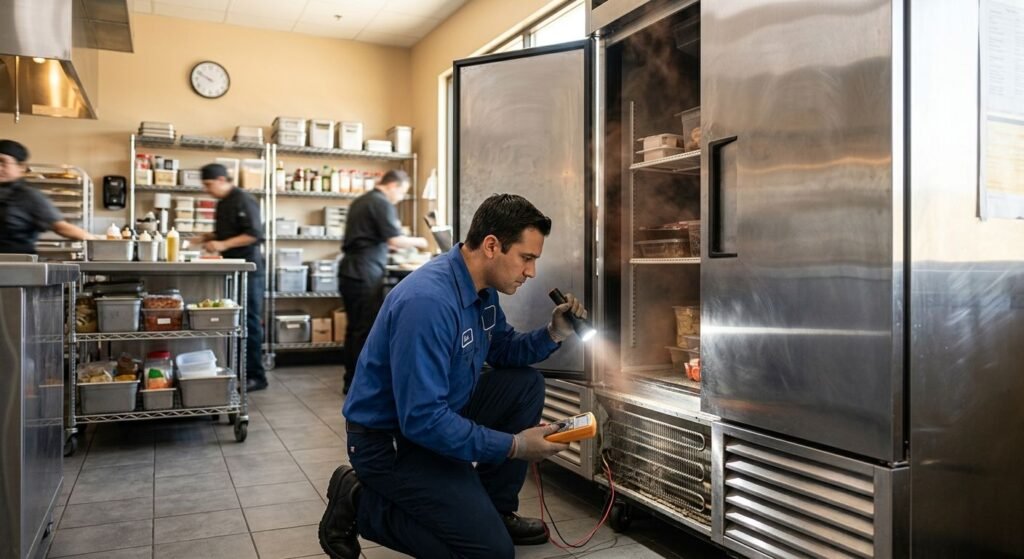
Commercial Refrigeration
A commercial refrigerator that’s not cooling is most often a dirty condenser coil or a failing door seal, both of which you can check yourself in under five minutes before calling for service. Here’s what to look for first, in what order, and what points to a deeper mechanical problem.
Key Takeaways
- A dirty condenser coil is the single most common cause of a warm commercial refrigerator, and the easiest to check yourself.
- Phoenix’s dust and heat load coils faster than milder climates, so check them more often here than a manual written for another region would suggest.
- A door that won’t hold a seal wastes cooling capacity around the clock, not just when it’s opened.
- If the coil is clean and the seal is tight but the unit still isn’t cooling, that points to a compressor or refrigerant issue needing a technician.
Top Causes of a Commercial Refrigerator Not Cooling
Before assuming the worst, work through the causes in order of how common and how easy to check they are.
- Dirty condenser coil: Dust and grease buildup blocks airflow across the coil, so the unit can’t reject heat efficiently and struggles to hit its setpoint.
- Worn door gasket: A gasket that’s cracked, warped, or no longer magnetized lets warm air leak in continuously.
- Failing evaporator fan: If the fan inside the unit isn’t circulating air, cold spots and warm spots develop unevenly throughout the cabinet.
- Overloading the unit: Packing a refrigerator or walk-in beyond its rated capacity blocks airflow between items and can make an otherwise healthy unit struggle to maintain temperature.
- Compressor strain or failure: A compressor that’s been overworking a dirty system for months can eventually fail outright, which is the most expensive cause on this list and the one most worth preventing.
- Refrigerant issues: Low refrigerant from a slow leak reduces cooling capacity gradually, often mistaken for a “weak” unit rather than a leak needing repair.
| Symptom Pattern | Most Likely Cause |
|---|---|
| Warm throughout, compressor runs constantly | Dirty condenser coil |
| Warm near the door, cold in the back | Worn door gasket |
| Uneven temperature, ice buildup on one wall | Failing evaporator fan |
| Gradual warming over several weeks | Slow refrigerant leak |
| Compressor clicking on and off rapidly | Electrical or start relay issue |
Why Phoenix Heat Makes This Worse
A condenser coil rejects heat into the surrounding air, and when that air is already near or above 100 degrees for months at a stretch, the coil has less margin to work with even when clean. Add construction dust and dry desert air, and coils in the Phoenix Metro Area foul up meaningfully faster than the same equipment would in a cooler, less dusty region. A cleaning interval that’s adequate elsewhere often isn’t enough here, which is why we generally recommend more frequent coil checks for Tempe-area kitchens than a manufacturer’s generic maintenance schedule assumes.
Quick Checks Before You Call a Technician
Look at the condenser coil (usually behind a rear or bottom panel) for visible dust or grease buildup, and clean it with a soft brush or coil cleaner if needed.
Close the door on a dollar bill or sheet of paper at several points along the frame. If it slides out easily anywhere, the gasket seal has failed at that spot.
Listen for the evaporator fan running inside the unit when the door is closed. Silence, or grinding, points to a fan problem.
Check that the unit isn’t packed beyond capacity, since blocked airflow between stored items can mimic a mechanical cooling problem.
If all four check out and the unit still isn’t holding temperature, the issue is likely compressor or refrigerant related and needs a technician.
Preventing the Problem From Coming Back
A one-time coil cleaning fixes today’s symptom, but coils foul up again on their own schedule, especially in Arizona’s dust and heat. Scheduling a quarterly coil check, alongside a gasket inspection at the same visit, catches both of the top two causes before they resurface as another warm-unit complaint. This is the same logic behind a structured maintenance plan: the small recurring task is far cheaper than the compressor replacement that eventually follows if it’s skipped repeatedly.
Checked the coil and the seal and still running warm? Let’s take a look.
When to Bring in a Professional
Compressor diagnostics and refrigerant work require certified technicians, both for safety and because refrigerant handling is federally regulated. Our certified technicians provide same-day service, based on availability, across the Phoenix Metro Area, including Tempe, Scottsdale, Chandler, Gilbert, Mesa, and Paradise Valley, and every repair uses OEM parts to keep the fix reliable.
Frequently Asked Questions
Why is my walk-in cooler running but not cooling?
This usually points to a dirty condenser coil, a failing evaporator fan, or low refrigerant, in that order of likelihood. Check the coil and door seal first before assuming a compressor problem.
How often should I clean the condenser coil in Arizona?
Given the dust and heat in the Phoenix Metro Area, a quarterly check is a reasonable baseline for most kitchens, with more frequent cleaning for units near cooking equipment or high-traffic areas.
Can overloading a refrigerator cause cooling problems?
Yes. Packing a unit beyond its rated capacity blocks airflow between items, which can make an otherwise healthy refrigerator struggle to maintain even temperature throughout.
Can I recharge refrigerant myself?
No. Refrigerant handling is regulated under EPA Section 608 and requires a certified technician, both for legal compliance and for your own safety.
Written and reviewed by Ice Age Commercial. We troubleshoot commercial refrigeration failures across the Phoenix Metro Area every week and built this guide around the causes we see most often.
Get Your Refrigeration Back to Temperature
Ice Age Commercial repairs commercial refrigerators, walk-in coolers, and freezers for restaurants and grocers across Tempe and the Phoenix Metro Area.