
Commercial Refrigeration
A scheduled commercial refrigeration maintenance plan typically costs a fraction of what a single reactive repair does, and in Phoenix’s climate, the gap is wider than most operators expect. Here’s what a proper plan actually includes, what it costs, how the maintenance tiers compare, and how the math works out over a year.
Key Takeaways
- Condenser coil cleaning and door gasket checks are the two highest-impact tasks on a maintenance visit, and the ones most often skipped.
- Arizona’s heat and dust load condensers faster than in milder climates, which shortens the safe interval between cleanings.
- A structured plan trades unpredictable reactive repair costs for a flat, budgetable line item.
- Reduced compressor strain from clean coils and tight seals extends equipment life by years, not months.
- Maintenance records also support Maricopa County health inspections, which ask for documented equipment upkeep.
What a Real Maintenance Plan Includes
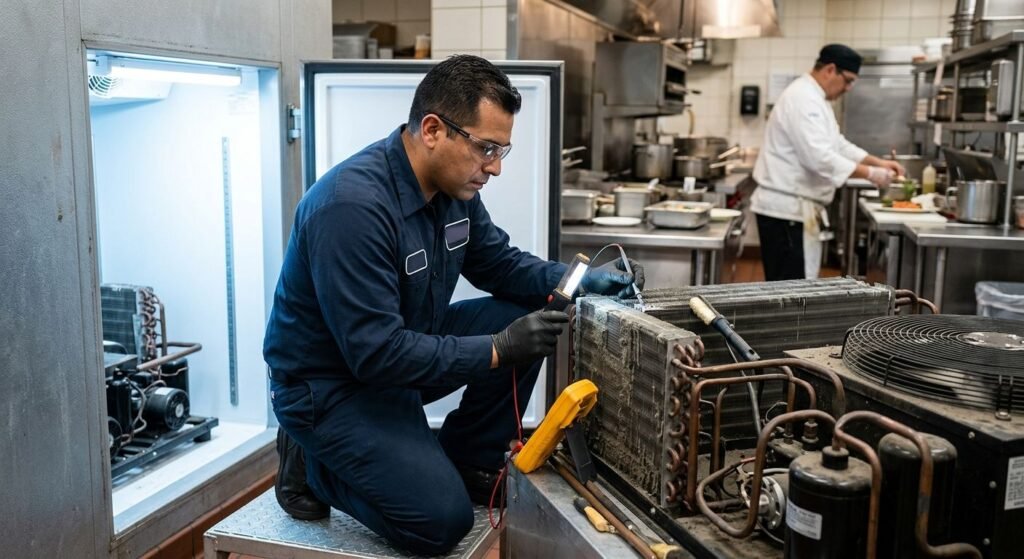
A commercial refrigeration maintenance plan is only as good as the tasks actually performed at each visit. At minimum, a proper visit should include condenser coil cleaning, evaporator fan inspection, door gasket and seal checks, thermostat calibration, drain line clearing, and a check of electrical connections and contactors. Skipping any one of these lets a small, cheap problem grow into an expensive one.
- Condenser coil cleaning: Dust and grease buildup on the coil forces the compressor to work harder to move the same amount of heat, which raises energy use and shortens compressor life.
- Door gasket and seal checks: A worn gasket lets warm air leak in continuously, which shows up as a unit that runs constantly but never quite holds temperature.
- Evaporator fan and coil inspection: Ice buildup or a failing fan motor reduces airflow and creates uneven cooling inside the unit.
- Thermostat calibration: A thermostat that reads even a few degrees off can mean product sitting outside safe holding temperature without anyone noticing.
- Drain line clearing: A clogged condensate drain backs up inside the unit, which can lead to standing water, ice buildup, and even structural damage over time.
- Electrical connections and contactors: Loose or corroded connections create resistance that generates heat, a slow-building fire and failure risk that a visual and thermal check catches early.
Why This Matters More in Phoenix
Condensers reject heat into the surrounding air, and Arizona kitchens ask them to do that against ambient temperatures that regularly clear 100 degrees for months at a time. Dust from surrounding construction and outdoor air intake adds to the coil-fouling problem faster than it would in a milder climate. The practical result: a maintenance interval that’s fine in a temperate city can leave an Arizona unit running dirty and overworked for weeks longer than it should, accelerating exactly the compressor wear a maintenance plan is designed to prevent.
Comparing Maintenance Tiers
Most providers structure plans around visit frequency and scope, and picking the right tier depends on your equipment count and how hard your kitchen runs it.
| Plan Tier | Visit Frequency | Best For |
|---|---|---|
| Basic | Semi-annual | Low-volume kitchens with newer equipment |
| Standard | Quarterly | Most restaurants and grocers in the Phoenix Metro Area |
| Premium | Monthly, plus priority scheduling | High-volume kitchens or equipment showing early wear |
A quarterly visit schedule is a reasonable default for most Tempe-area kitchens given the climate factors above, with premium-tier monthly visits worth considering for equipment that’s already older or showing signs of strain.
Cost Comparison: Plan vs. Reactive Repair
| Approach | Typical Annual Cost | What You Get |
|---|---|---|
| Structured maintenance plan | $800-$1,200 per unit, varies by equipment count | Scheduled visits, predictable budgeting, documented records |
| Reactive repair only | Highly variable, often $1,000+ per unplanned service call | No prevention, higher risk of inventory loss, no compliance documentation |
The Real ROI: Fewer Reactive Repairs, Longer Equipment Life
The financial case for a maintenance plan isn’t abstract. A dirty condenser coil forces the compressor to run longer and hotter to hit the same setpoint, which accelerates wear on the exact component that’s most expensive to replace. Regular coil cleaning and gasket replacement, done on a schedule rather than after a failure, measurably cuts the frequency of reactive service calls and extends compressor life by two to five years in typical use. That reduction in reactive calls is also a reduction in the two most expensive outcomes a foodservice operator faces: spoiled inventory and unplanned downtime during service hours.
There’s a compliance angle too. Maricopa County health inspections look for documented, dated maintenance records as evidence that refrigeration equipment is being kept within safe operating range. A maintenance plan that logs each visit gives you that documentation automatically, instead of scrambling to reconstruct a service history during an inspection.
Want a plan built around your actual equipment count and kitchen layout, not a generic package?
When to Bring in a Professional
Routine coil cleaning and gasket inspection are reasonable for kitchen staff to check between visits, but compressor work, refrigerant handling, and electrical diagnostics need a certified technician, both for safety and because refrigerant handling is federally regulated. If a unit isn’t holding temperature despite a clean coil and a good seal, that’s a sign of a deeper mechanical issue worth a same-day diagnostic visit, based on technician availability, rather than a wait-and-see approach.
Frequently Asked Questions
How often should commercial refrigeration equipment be serviced in Phoenix?
Most units in the Phoenix Metro Area benefit from quarterly visits given the heat and dust load, though high-use equipment like walk-in coolers in busy kitchens may need condenser cleaning more frequently than that.
Do you offer service if something breaks between maintenance visits?
Yes. We provide same-day service, based on technician availability, for maintenance-plan customers and non-plan customers alike, in Tempe, Phoenix, Scottsdale, Chandler, Gilbert, Mesa, and Paradise Valley.
Is a maintenance plan worth it for a single-unit kitchen?
Even a single walk-in cooler or reach-in benefits from scheduled coil cleaning and gasket checks, since the cost of one prevented compressor failure typically exceeds a full year of plan visits.
What’s the difference between basic, standard, and premium maintenance tiers?
The tiers primarily differ in visit frequency: semi-annual for basic, quarterly for standard, and monthly with priority scheduling for premium. Most Tempe-area kitchens do well on a standard quarterly schedule given local heat and dust conditions.
Written and reviewed by Ice Age Commercial. Our technicians build maintenance schedules around the specific equipment and climate conditions we see across Tempe and the Phoenix Metro Area every week.
Build a Maintenance Plan Around Your Kitchen
Ice Age Commercial provides commercial refrigeration maintenance plans and repairs for restaurants, grocers, and convenience stores across Tempe and the Phoenix Metro Area.