
Commercial Refrigeration
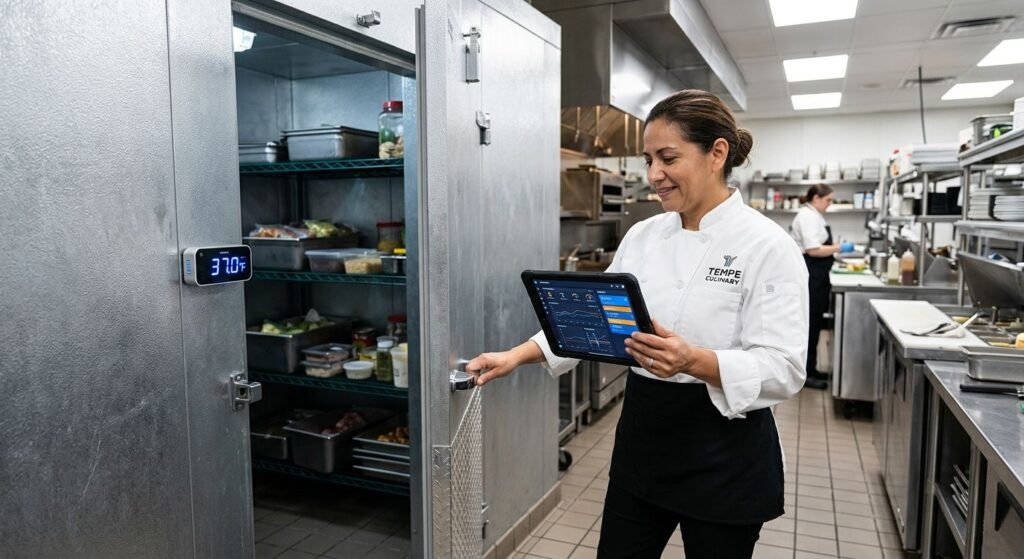
IoT temperature monitoring catches a failing walk-in cooler hours before staff would notice it on a routine check, which is often the difference between a minor repair and a full inventory loss. Here’s how the technology works, what it costs, how it compares to manual logging, and how it fits alongside a professional maintenance plan.
Key Takeaways
- Wireless sensors report temperature continuously, catching drift long before a manual twice-daily check would.
- Automated logging simplifies HACCP compliance documentation for Maricopa County health inspections.
- Real-time alerts let you respond to a failing unit before product spoils, not after.
- Sensor cost varies widely by connectivity type and unit count, and pays for itself after preventing a single spoilage event.
- The technology complements, rather than replaces, scheduled professional maintenance.
How IoT Temperature Monitoring Works
Wireless sensors placed inside each refrigeration unit report temperature readings at set intervals, typically every few minutes, to a central platform accessible from a phone or computer. When a reading crosses a set threshold, the system sends an alert to designated staff, giving you a window to respond before the unit warms enough to put product at risk. This is a meaningful upgrade from the traditional twice-daily manual temperature log, which can miss a problem that develops and resolves, or worsens, entirely between checks.
Manual Logging vs. IoT Monitoring
| Factor | Manual Logging | IoT Monitoring |
|---|---|---|
| Check frequency | Typically twice daily | Continuous, every few minutes |
| Staff time required | Ongoing, every shift | Minimal after setup |
| Detects overnight or weekend failures | No, only at next check | Yes, in real time via alert |
| Audit-ready documentation | Depends on staff consistency | Automatic and timestamped |
The gap that matters most is the middle row: a unit that starts failing right after the evening staff leaves can run warm for eight or more hours before a manual check catches it the next morning. A sensor system flags that same failure within minutes, often early enough to save the inventory entirely rather than just documenting the loss.
Simplifying HACCP Compliance
HACCP-based food safety plans require documented temperature monitoring, and manual logs are both time-consuming and prone to gaps when staff are busy. An automated system creates a continuous, timestamped record without relying on someone remembering to check and write it down, which is exactly the kind of documentation a Maricopa County health inspector wants to see during an audit.
What to Look For in a Sensor Platform
NSF-certified hardware, so the sensors themselves meet food-safety equipment standards.
Reliable connectivity that doesn’t depend solely on your kitchen’s WiFi, since a dropped connection during a real equipment failure defeats the purpose.
Configurable alert escalation, so a missed first alert reaches a second contact rather than going unnoticed.
Battery backup or independent power, so a power blip at the unit doesn’t also take down the monitoring itself.
The cheapest sensor platform on the market isn’t a bargain if it drops readings during the exact moment a unit starts failing.
What Sensor Systems Typically Cost
Pricing varies by connectivity type (WiFi-dependent systems tend to run less expensive than cellular-connected sensors that work independently of your kitchen’s network) and by how many units you’re monitoring. Most commercial platforms charge a hardware cost per sensor plus a monthly subscription for the monitoring platform and alerts. Weighed against the cost of a single spoiled walk-in cooler’s inventory, which can run into the thousands of dollars depending on what’s stored, the ongoing subscription cost is modest by comparison, especially once it’s prevented even one incident.
The ROI: Monitoring Plus Maintenance, Not Instead Of
IoT monitoring tells you when a unit is drifting out of range. It doesn’t fix the underlying cause, whether that’s a dirty condenser coil, a failing door seal, or a compressor issue. The real value comes from pairing continuous monitoring with a scheduled maintenance plan: the sensors catch problems early, and the maintenance visits address root causes before they become alerts in the first place. Operators who combine both typically see fewer reactive repair calls and less inventory loss than either approach alone.
Want to pair temperature monitoring with a maintenance plan built around your equipment?
When an Alert Means It’s Time to Call
A single brief alert, especially right after a delivery when the door was open longer than usual, often resolves itself. A sustained alert, or repeated alerts from the same unit within a short window, is worth a same-day technician visit, based on availability, rather than waiting to see if it corrects on its own.
Frequently Asked Questions
Does IoT monitoring replace manual temperature logs?
It can, provided your local health department accepts automated digital records, which is increasingly common. Confirm the specific requirement with your Maricopa County inspector before fully retiring manual logs.
How quickly do alerts arrive after a temperature deviation?
Most platforms report within minutes of a sensor reading crossing the configured threshold, far faster than a twice-daily manual check would catch the same issue.
What does a sensor system typically cost?
Cost depends on connectivity type and the number of units monitored, with WiFi-based systems generally less expensive than cellular-connected ones. Most platforms combine a hardware cost with a monthly monitoring subscription.
Do you install and service these sensor systems?
We can help evaluate sensor platforms for your kitchen and pair monitoring with a preventive maintenance plan so alerts translate into fast, effective repairs.
Written and reviewed by Ice Age Commercial. We service the refrigeration equipment behind these sensor readings across Tempe and the Phoenix Metro Area every week.
Pair Monitoring With Real Maintenance
Ice Age Commercial maintains and repairs the commercial refrigeration equipment your monitoring system is watching, across Tempe and the Phoenix Metro Area.