
Restaurant Equipment Maintenance
How to clean a meat slicer comes down to one rule from the FDA and a handful of habits: clean and sanitize it following the manufacturer’s instructions at least every four hours of continuous use, take it apart far enough to reach every food-contact surface, and keep the blade sharp so it cuts instead of tearing. A slicer that is dirty, dull, or out of adjustment is a food safety risk and an injury risk at the same time. This guide covers the cleaning routine, blade care, who is allowed to do the work, and the signs that mean a slicer needs a technician.
Key Takeaways
- The FDA says deli slicers should be cleaned and sanitized per the manufacturer’s instructions at least every four hours, and wiping off visible debris is not enough.
- Under federal child labor rules, employees under 18 may not operate or clean power-driven meat slicers, including hand-washing the disassembled parts.
- Food soil collects in places that are easy to miss, such as the inside of the blade guard, so clean those areas every time.
- Sharpen with the slicer’s own sharpener, as your manual directs, and wash the blade thoroughly afterward.
- A blade that stays dull after sharpening, new vibration, or a motor that struggles all mean it is time for service, not another adjustment.
The Four-Hour Rule and Why It Exists
The FDA’s guidance on commercial deli slicers states they should be cleaned and sanitized per the manufacturer’s instructions at least once every four hours. The agency ties this to the way food soils and disease-causing microorganisms can build up on slicers, and it tells operators to keep the cleaning instructions posted near the slicer and follow them closely.
The four-hour clock applies to continuous use. A slicer used a few times a day still needs a full clean at close, and you should clean it whenever you switch to a different product that could pass an allergen or contaminate another item. Write the cleaning times on a log so you can show the routine happened.
Who Is Allowed to Clean a Meat Slicer
The U.S. Department of Labor lists power-driven meat slicers among the machines that workers under 18 may not operate, feed, set up, adjust, repair, or clean. That includes hand-washing the disassembled parts. The restriction applies in restaurants and delis alike. Read the DOL fact sheet on cooking and baking and make sure your schedule keeps minors away from the slicer, including at closing when cleaning happens.
Step-by-Step Cleaning Routine
Always follow your model’s manual, because slicers differ in how they come apart. The general sequence is the same:
Clean and sanitize a slicer
Turn the slicer off, unplug it, and set the gauge plate to zero so the blade edge is covered.
Remove leftover product, then remove the removable parts your manual allows, such as the carriage, blade guard, and product pusher.
Wash all parts and the body with detergent and warm water. Pay extra attention to the inside of the blade guard, the seams, the gauge plate, and the area behind the blade.
Clean the blade itself carefully, following the manual’s wiping direction, and rinse every part to remove detergent.
Sanitize with an approved sanitizer at the concentration on its label, confirm it with test strips, and let the parts air dry.
Reassemble, wipe the exterior, record the cleaning time, and reconnect power only when everything is back in place.
Never clean a slicer while it is plugged in, and never reach toward the blade edge with bare hands.
The Spots People Miss
The FDA specifically highlights food soil that accumulates on the inside of the blade guard, at the plastic piece there, as a problem area. Other places that hold residue are the seams between the carriage and the body, the gauge plate and its mounting, the area behind the blade, and the underside of the product tray. If you have to push a cloth into a crevice, that crevice needs attention at every cleaning.
The FDA also advises checking seams and gaskets while the slicer is assembled. If a seal is cracked or a gasket has come loose, soil can get into places you cannot reach without a teardown, and proper servicing may require removing components and reapplying sealants or gaskets. That is a job for a qualified technician, not a quick fix.
Blade Care and Sharpening
A sharp blade is safer than a dull one. A dull blade needs more force, tears product, and slips. Signs that the blade needs attention include ragged or shredded slices, thicker edges on one side, and a feeling that you are pushing the product harder than before.
- Use the built-in sharpener. Most commercial slicers have a sharpening assembly designed for that blade. Follow your manual for how long to run it and how much pressure to use.
- Never freehand. Improvised sharpening can ruin the blade edge and create a hazard.
- Clean the blade after sharpening. Sharpening produces fine metal and abrasive particles. Wash and sanitize the blade and nearby parts before the next use.
- Keep the sharpener clean and in good condition. Worn or loaded stones stop working and should be replaced per the manual.
- Do not skip the guard checks. The blade guard and gauge plate are safety features, and a slicer missing or damaged guards should not be used.
Slicer cutting poorly even after cleaning and sharpening? Ice Age Commercial can inspect the blade, belt, carriage, and motor and get it cutting cleanly again.
What the Symptoms Mean
| Symptom | Likely cause | What to do |
|---|---|---|
| Ragged, torn, or shredded slices | Dull blade or worn sharpener | Sharpen per the manual, replace worn stones, and call if it persists |
| Uneven slice thickness | Gauge plate out of adjustment, worn carriage, product at the wrong temperature | Check the plate zero setting, then call if it still varies |
| Vibration or new noise | Damaged blade, loose parts, worn bearings or belt | Stop using it and schedule service |
| Motor stalls or runs hot | Overload, binding carriage, failing motor | Stop and call a technician |
| Carriage sticks or drags | Dried lubricant or debris on the slide | Clean it and relubricate with an approved product, then call if it continues |
| Residue returns quickly after cleaning | Cracked seam or gasket trapping soil | Schedule inspection and gasket service |
When to Call for Service
Call when the blade will not cut cleanly after sharpening, when the machine vibrates or makes new noise, when the motor struggles, or when a guard or gasket is damaged. Ice Age Commercial offers same-day service based on availability across Tempe and the Phoenix Metro Area. Learn more about our deli meat slicer repair service.
Slicers belong on a broader routine. Our restaurant kitchen equipment maintenance checklist shows how slicer care fits with refrigeration, ice machines, and cooking equipment, and our restaurant equipment safety inspection guide covers what inspectors check, including machine guards.
Frequently Asked Questions
How often should a commercial meat slicer be cleaned?
The FDA says deli slicers should be cleaned and sanitized per the manufacturer’s instructions at least every four hours of continuous use. Clean it fully at the end of the day, and any time you change products or see visible soil.
Can I use WD-40 or a household oil on a slicer?
No. Use only lubricants approved in your manual for food equipment, and keep them off food-contact surfaces. A household penetrating oil should never touch the blade, carriage, or any part that meets food.
Can a 17-year-old clean the slicer?
No. Federal child labor rules bar employees under 18 from operating or cleaning power-driven meat slicers, including hand-washing the disassembled parts.
How do I know when the blade needs sharpening?
Look for ragged or shredded slices, thicker edges on one side, or extra force required to push the product. Sharpen with the slicer’s built-in sharpener following your manual, and wash the blade afterward.
Written and reviewed by Ice Age Commercial. We repair deli slicers and commercial kitchen equipment across Tempe and the Phoenix Metro Area. Always follow your slicer manufacturer’s instructions, and your local health authority has the final word on requirements.
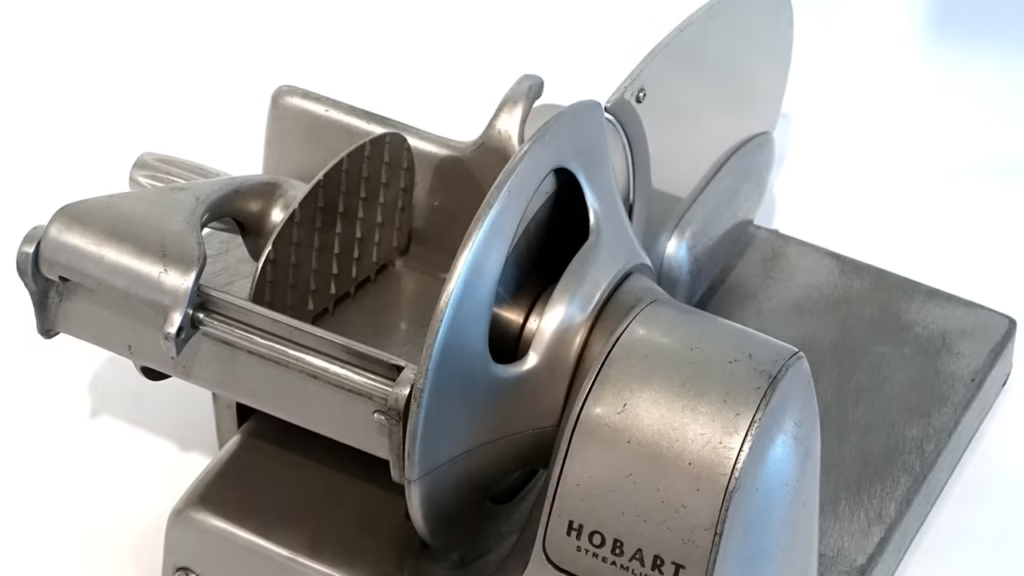
Banner photo: Hobart Streamliner slicer by Daderot, licensed under CC BY-SA 4.0, via Wikimedia Commons.
Keep Your Slicer Safe and Sharp
Ice Age Commercial repairs deli slicers and commercial kitchen equipment for restaurants, grocers, and convenience stores across Tempe and the Phoenix Metro Area. Same-day service is available based on availability.