
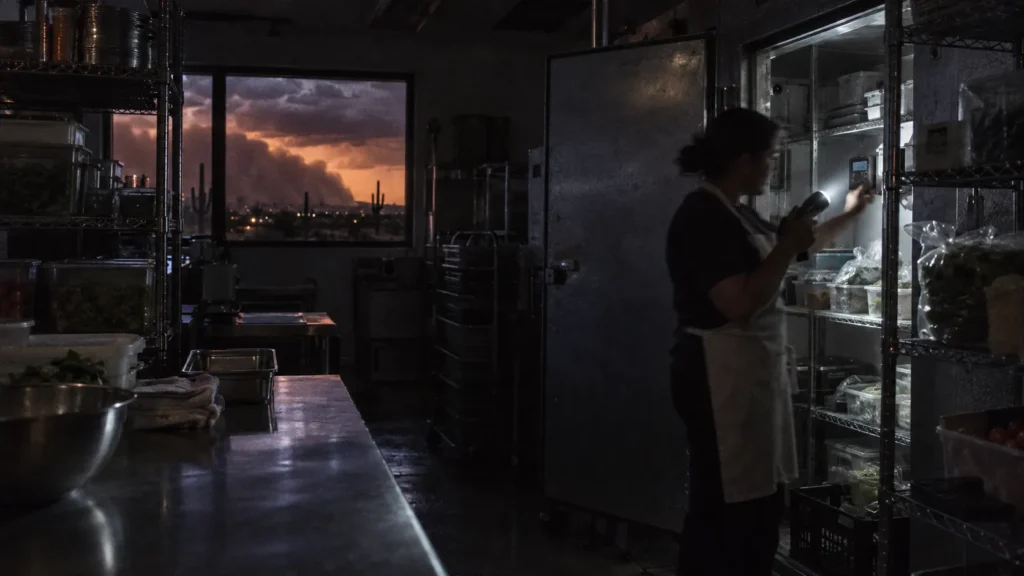
Arizona’s monsoon season regularly knocks out power to thousands of homes and businesses at once, and a commercial walk-in cooler that loses power at 2 p.m. starts losing food safety by 4 p.m. Here’s the action plan for protecting your inventory, your staff, and your health inspection score when the lights go out.
Key Takeaways
- Arizona’s monsoon season officially runs June 15–September 30, with the most active storms typically mid-July through mid-August.
- A closed refrigerator holds a safe temperature for about 4 hours; discard perishable food that’s been above 40°F for 2 hours or more.
- A full freezer stays safe for about 48 hours, a half-full freezer for about 24 hours, as long as the door stays closed.
- Portable generators need at least 20 feet of clearance from doors, windows, and vents; generator exhaust kills over 500 Americans a year.
- A single dust storm on August 20, 2026 cut power to roughly 17,000 SRP customers in Maricopa County alone, so this isn’t a hypothetical risk for Tempe kitchens.
Why Monsoon Season Is a Real Threat to Your Kitchen
Arizona’s monsoon season runs from June 15 through September 30 each year, a fixed window the National Weather Service has used since 2008. Storm activity typically peaks between mid-July and mid-August, when haboobs, lightning, and straight-line winds move across the Phoenix Metro with little warning.
This isn’t an abstract risk. On August 20, 2026, a Category 2 dust storm swept into the Valley overnight with winds up to 68 mph in the East Valley and 714 recorded lightning strikes, cutting power to about 17,000 Salt River Project customers in Maricopa County. A similar dust storm on July 12–13, 2026 left thousands more without power. For a restaurant, grocer, or convenience store in Tempe, that’s the kind of event that can hit your walk-in cooler on any given afternoon between June and September, often with no more warning than a wall of dust on the horizon.
The Food-Safety Clock: What FDA and USDA Actually Say
Once the power goes out, food safety becomes a countdown. The FDA and USDA guidelines are specific, and they don’t leave much room for judgment calls: keep the doors closed, watch the clock, and rely on a thermometer instead of a smell test.
How long your equipment stays safe with the doors closed
Based on FDA/USDA power-outage food safety guidance. Regardless of these windows, discard any perishable food that has been above 40°F for 2 hours or more.
For refrigerated food, an unopened door keeps contents cold for about 4 hours. But the harder rule is the 40°F threshold: any perishable item, meat, poultry, fish, eggs, or leftovers, that sits above 40°F for 2 hours or more should be thrown out, regardless of how it looks or smells. For frozen food, a full freezer holds a safe temperature for about 48 hours with the door closed, dropping to about 24 hours if it’s only half full. When power returns, check an appliance thermometer before assuming anything is safe: food that still contains ice crystals or reads 40°F or below can be refrozen or cooked, but when in doubt, throw it out.
Your Outage Action Checklist
Keep an appliance thermometer in every cooler and freezer, and check it the moment power returns rather than guessing by feel.
Keep doors closed during the outage. Every check-in opens the clock back up and loses you safe hours.
Line up a dry ice source before monsoon season starts, not while a storm is already knocking out power across the Valley.
If you run a backup generator, keep it at least 20 feet from any door, window, or vent, with exhaust pointed away from the building.
Print this list and keep a copy near the kitchen manager’s station; a plan you can’t find during a storm isn’t a plan.
Want a walk-through of your kitchen’s backup-power readiness before this year’s storms peak?
Call (602) 551-6195Protecting Your Equipment and Your Health Inspection Score
Maricopa County health code requires commercial refrigerators to hold food at or below 40°F and freezers at or below 0°F, the same thresholds the FDA uses nationally. A prolonged monsoon outage puts both your inventory and that compliance status at risk at the same time. Discarded stock after a bad outage is exactly the kind of loss that a regular preventive maintenance plan and a clear-eyed backup power plan help you avoid, since equipment that’s already running efficiently gives you a longer safety window when the power does go out, and a documented action plan means your team isn’t improvising during a dust storm.
Frequently Asked Questions
How long does a commercial refrigerator stay safe during a power outage?
About 4 hours with the door closed. Regardless of that window, any perishable food that’s been above 40°F for 2 hours or more should be discarded.
Can I run a generator inside my kitchen or storage room?
No. Portable generators need at least 20 feet of clearance from any door, window, or vent, with exhaust directed away from the building. Carbon monoxide from generators is odorless and kills more than 500 Americans a year.
When is Arizona’s monsoon season?
Officially June 15 through September 30, per National Weather Service dates set in 2008. Storm activity typically peaks between mid-July and mid-August.
What if I’m not sure whether food is still safe?
When in doubt, throw it out. Use an appliance thermometer to check the actual temperature rather than relying on smell or appearance.
Written and reviewed by Ice Age Commercial. We repair and maintain commercial refrigeration for restaurants, grocers, and convenience stores across Tempe and the Phoenix Metro Area, including pre-monsoon readiness checks.
Ready for This Year’s Monsoon Season?
Ice Age Commercial helps Tempe and Phoenix Metro kitchens prepare their refrigeration equipment before storm season hits, and responds fast when an outage puts inventory at risk.
Get a Quote