Commercial Kitchen Repair
Most commercial kitchen equipment problems fall into a handful of predictable categories: refrigeration not holding temperature, cooking equipment not heating evenly, ice machines producing too little or cloudy ice, and dishwashers not draining. Here’s a practical, step-by-step troubleshooting approach for each, plus a clear line for when to stop and call a technician.
Key Takeaways
- Refrigeration problems usually trace back to a dirty condenser coil or a failed door seal before anything more serious.
- Cooking equipment issues often come down to a heating element, thermostat calibration, or gas supply problem.
- Cloudy or undersized ice is almost always a water filtration or scale buildup issue, not a compressor failure.
- Dishwasher drainage problems are frequently a clogged screen or line, not a pump failure.
- Documenting your checks supports Maricopa County health inspections, which look for evidence of routine equipment monitoring.
Before You Start: Safety Steps
Before troubleshooting any equipment, shut off power at the breaker for electrical issues, and shut off the gas supply valve if you suspect a gas leak or ignition problem, then ventilate the area before continuing. Refrigerant handling and gas line repair are not DIY tasks under any circumstances, and both require a certified technician. If you ever smell gas near a range, oven, or fryer connection, treat it as a stop-work situation: shut the valve, ventilate, and call a technician rather than attempting to isolate the source yourself.
It also helps to have a simple written log on hand before you start, even a notebook by the equipment. Recording the date, the symptom, and what you checked turns a one-off troubleshooting session into a running maintenance history, which is exactly the kind of documentation a health inspector or a technician diagnosing a recurring problem will want to see.
Diagnosing Refrigeration Problems
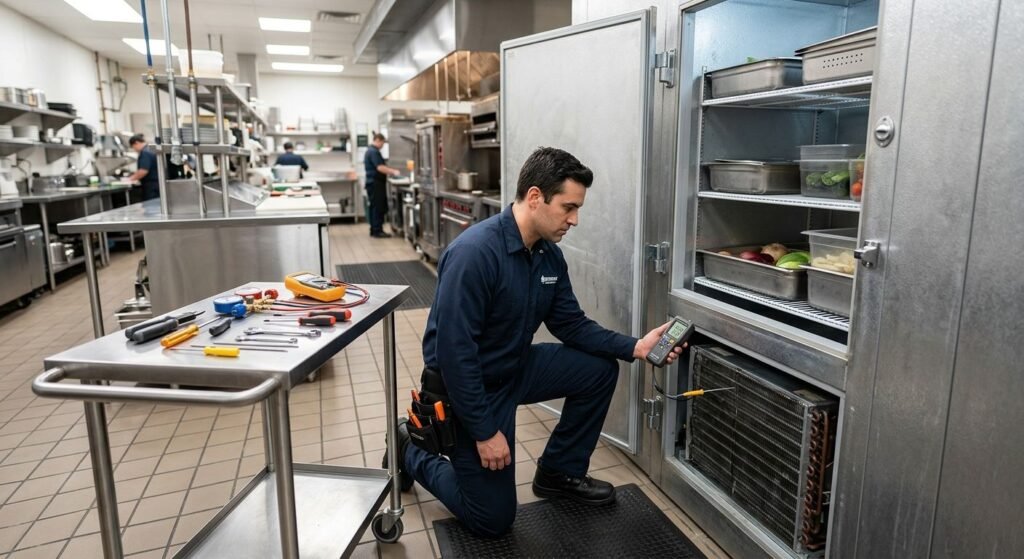
Refrigeration issues account for the largest share of service calls in a typical commercial kitchen, and the good news is that most of them trace back to one of a few root causes.
- Unit running but not cooling: Check the condenser coil for dust or grease buildup first, then check the door gasket with the dollar-bill test (close the door on a bill; if it pulls out easily, the seal has failed).
- Temperature fluctuating throughout the day: Often points to a failing evaporator fan or a thermostat that needs calibration, especially if the fluctuation correlates with how often the door is opened.
- Compressor short-cycling (turning on and off rapidly): Can indicate low refrigerant, a failing start relay, or an electrical issue, all of which need a technician rather than a DIY fix.
- Ice buildup inside a walk-in freezer: Usually points to a door seal problem or a defrost cycle that isn’t completing correctly.
- Unusual noise from the compressor or condenser fan: Grinding or rattling noises often mean a fan motor bearing is failing, which is worth addressing before it fails completely and the unit stops cooling altogether.
Diagnosing Cooking Equipment Problems
- Oven not reaching set temperature: Verify the thermostat calibration and check that the heating element or burners are igniting evenly across the cavity.
- Range burners igniting unevenly: Usually a clogged burner port or a pilot light issue, both simple for a technician to clear during a routine visit.
- Fryer not heating or overheating: Check the thermostat first; if it reads correctly but the oil temperature doesn’t match, the heating element likely needs replacement.
- Grill or griddle with cold spots: Often a sign of an uneven burner or a warped cooking surface, both worth a technician’s attention before food safety becomes a concern.
- Pilot light won’t stay lit: This commonly points to a failing thermocouple, a small and inexpensive part that a technician can typically replace in a single visit.
| Symptom | Likely Cause | DIY Check Possible? |
|---|---|---|
| Refrigerator running warm | Dirty condenser coil or worn gasket | Yes |
| Oven uneven heating | Thermostat calibration or heating element | Partial (calibration check only) |
| Cloudy or small ice cubes | Scale buildup or dirty water filter | Yes (filter replacement) |
| Dishwasher not draining | Clogged screen or drain line | Yes |
| Pilot light won’t stay lit | Failing thermocouple | No, technician required |
Diagnosing Ice Machine Problems
Ice machines are often overlooked in a troubleshooting routine, but they fail in fairly predictable ways tied to water quality and scale buildup rather than mechanical failure.
- Cloudy or oddly shaped ice: Almost always a water filtration issue or mineral scale buildup inside the machine, both of which respond well to a filter change and a descaling cycle.
- Ice production slowing down over time: A gradual decline, rather than a sudden stop, usually points to scale buildup restricting water flow to the freeze plate.
- Machine stops producing ice entirely: Check that the water supply valve is open and the inlet filter isn’t fully blocked before assuming a compressor issue.
- Ice tastes or smells off: This points to a sanitation issue inside the bin or water lines, which needs a full clean rather than a mechanical repair.
Dishwasher Drainage Checklist
Clear the drain screen of food debris, the most common cause of slow draining.
Check the drain line for kinks or blockages between the unit and the wall connection.
Confirm the drain pump is running during the drain cycle; silence points to a pump or motor issue.
Inspect the spray arms for clogged nozzles, which can mimic a drainage problem by leaving standing water and food residue behind.
If all four check out and drainage is still slow, the issue is likely inside the pump assembly and needs a technician.
Why Arizona Conditions Change the Troubleshooting Picture
Heat and hard water both play a bigger role in Phoenix Metro kitchens than in milder, softer-water regions. Condenser coils foul faster in dusty, high-heat conditions, which means a refrigeration unit that’s “running but not cooling well” is statistically more likely to be a coil problem here than the same complaint would be elsewhere. Arizona’s hard water also accelerates scale buildup in ice machines and dishwashers, so those two categories of equipment often need more frequent filter changes and descaling than a manufacturer’s generic maintenance schedule assumes.
Why Documentation Matters
Keeping a simple log of what you checked and when, even for minor issues resolved without a service call, gives you a documented maintenance history that supports Maricopa County health inspections. Inspectors look favorably on kitchens that can show routine monitoring, not just repair records after something breaks. A basic log with date, equipment, symptom, and resolution is enough; it doesn’t need to be elaborate to be useful during an audit.
Still isn’t cooling properly after a coil clean and a seal check? We’re available for same-day diagnostics, based on availability.
When These Checks Aren’t Enough
Refrigerant leaks, electrical faults beyond a simple breaker reset, and gas line issues all require a certified technician, both for safety and because refrigerant handling is federally regulated under EPA Section 608. If your own checks don’t resolve the issue within a reasonable time, further troubleshooting usually just delays getting equipment back online, and in the case of gas or refrigerant, continued DIY attempts carry real safety and compliance risk.
Frequently Asked Questions
What should I check first when a walk-in cooler isn’t holding temperature?
Start with the condenser coil for dust buildup, then check the door seal with the dollar-bill test. These two checks resolve the majority of temperature complaints without needing a technician visit.
Why is my commercial oven not reaching the set temperature?
This is usually a thermostat calibration issue or an uneven heating element. A technician can verify calibration and test the element directly.
Why is my ice machine producing cloudy ice?
Cloudy ice almost always points to a water filtration issue or mineral scale buildup inside the machine, both of which are addressed with a filter change and descaling rather than a mechanical repair.
How often should I check equipment in Arizona’s climate versus elsewhere?
More often than a generic manufacturer schedule assumes. Heat accelerates condenser coil fouling, and hard water accelerates scale buildup in ice machines and dishwashers, so a monthly visual check is a reasonable baseline here even when equipment seems to be running fine.
When should I stop troubleshooting and call a professional?
Any suspected gas leak, refrigerant issue, or electrical fault beyond a breaker reset should go straight to a certified technician rather than further DIY troubleshooting.
Written and reviewed by Ice Age Commercial. We diagnose commercial kitchen equipment across Tempe and the Phoenix Metro Area and built this guide around the issues we see most often on service calls.
When DIY Troubleshooting Isn’t Enough
Ice Age Commercial repairs refrigeration, cooking equipment, ice machines, and dishwashers for restaurants and grocers across Tempe and the Phoenix Metro Area.