

For any business in the foodservice industry, your equipment isn’t just a set of tools—it’s the engine that drives your entire operation. From refrigerators and ovens to ice machines and dishwashers, these appliances are the unsung heroes of your daily workflow. When one of them breaks down, it’s far more than a minor hiccup. It’s a full-blown emergency that can threaten your revenue, spoil your inventory, and damage your reputation.
That’s where professional commercial appliance repair services come in. These are the experts you call to diagnose, fix, and maintain the complex machinery that keeps your business running smoothly. Think of it as an investment in pure, uninterrupted business continuity.
Why Smart Businesses Invest in Appliance Repair

Picture a packed house on a Friday night. The kitchen is humming, orders are flying, and then it happens: your main deep fryer goes cold. Suddenly, the entire operation grinds to a halt. The kitchen staff scrambles, orders start backing up, and you can feel the customer satisfaction dropping with every passing minute.
This nightmare scenario highlights a fundamental truth: equipment downtime is a business killer. It creates a costly domino effect that ripples through every part of your operation.
The problem goes way beyond the repair bill itself. The real cost of a breakdown includes lost sales from dishes you can’t make, expensive food inventory that spoils, and a hit to the reputation you’ve worked so hard to build. By investing in professional commercial appliance repair services, you’re not just fixing a machine; you’re making a strategic decision to protect your business from chaos and keep your doors open.
The True Cost of Equipment Failure
It’s easy to see appliance repair as just another expense, but that’s a shortsighted view. A single equipment failure can set off a chain reaction of financial and operational problems. Proactive maintenance and fast, reliable repairs are your best defense against these much larger, more damaging losses.
When a critical appliance fails, the impact is felt immediately and can linger long after the technician leaves. The table below breaks down the cascading effects.
The True Cost of Commercial Appliance Downtime
| Impact Area | Immediate Costs | Long-Term Consequences |
|---|---|---|
| Revenue | Lost sales from menu items you can’t prepare or serve. | Damage to customer loyalty; diners may not return. |
| Inventory | Spoilage of perishable goods (e.g., a broken freezer). | Disrupted supply chain and rushed, costly reordering. |
| Operations | Reduced staff productivity and workflow disruption. | Lower team morale and potential for staff burnout. |
| Reputation | Negative online reviews and poor word-of-mouth. | Difficulty attracting new customers and rebuilding trust. |
As you can see, the cost of a broken machine is far greater than the price of a new part.
This understanding—that repair is often far more economical than dealing with the fallout of failure—is a major driver in the industry. For context, the home appliance repair market alone was valued at $18.2 billion in 2023 and is projected to climb to $28.5 billion by 2032. This growth shows a clear trend: people recognize that fixing what you have is a smart financial move.
Smart business owners view appliance repair not as a cost center, but as an insurance policy against catastrophic operational failure and revenue loss.
At the end of the day, a dependable repair partner is your safety net, ensuring you can handle unexpected equipment failures without derailing your business. This is a vital piece of a much larger maintenance puzzle. For a more complete picture, an ultimate commercial building maintenance checklist can help you see where appliance care fits in. Moreover, for any business handling food, understanding the critical link between appliance upkeep and safety is non-negotiable, which is why we’ve detailed the importance of regular commercial appliance maintenance for food safety.
What to Expect From a Service Call
When a mission-critical piece of kitchen equipment goes down, the stress hits instantly. Knowing what a professional service call involves can help turn that chaotic moment into a structured, manageable process. Understanding the steps allows you to stay in control while the experts handle the technical side of your commercial appliance repair services.
Think of a good technician less like a simple mechanic and more like a “kitchen detective.” Their job isn’t just to see that a fryer isn’t heating up; it’s to dig in and find out why. They rely on specialized diagnostic tools and years of hands-on experience to trace the problem back to its root cause, ensuring you get a real fix, not just a temporary patch.
The Initial Diagnosis Phase
The first step is always a deep dive into the problem. The technician will probably start by asking you a few questions about how the appliance was acting before it failed. This isn’t small talk—your observations provide the first crucial clues.
From there, they’ll move on to a series of hands-on tests. This could mean checking electrical connections with a multimeter, inspecting mechanical parts for signs of wear and tear, or running specific diagnostic cycles. It’s a systematic approach that pinpoints the exact faulty component, eliminating guesswork and preventing you from paying for parts you don’t need.
The journey from your first call to a fully functional kitchen is a clear, logical process, as you can see below.
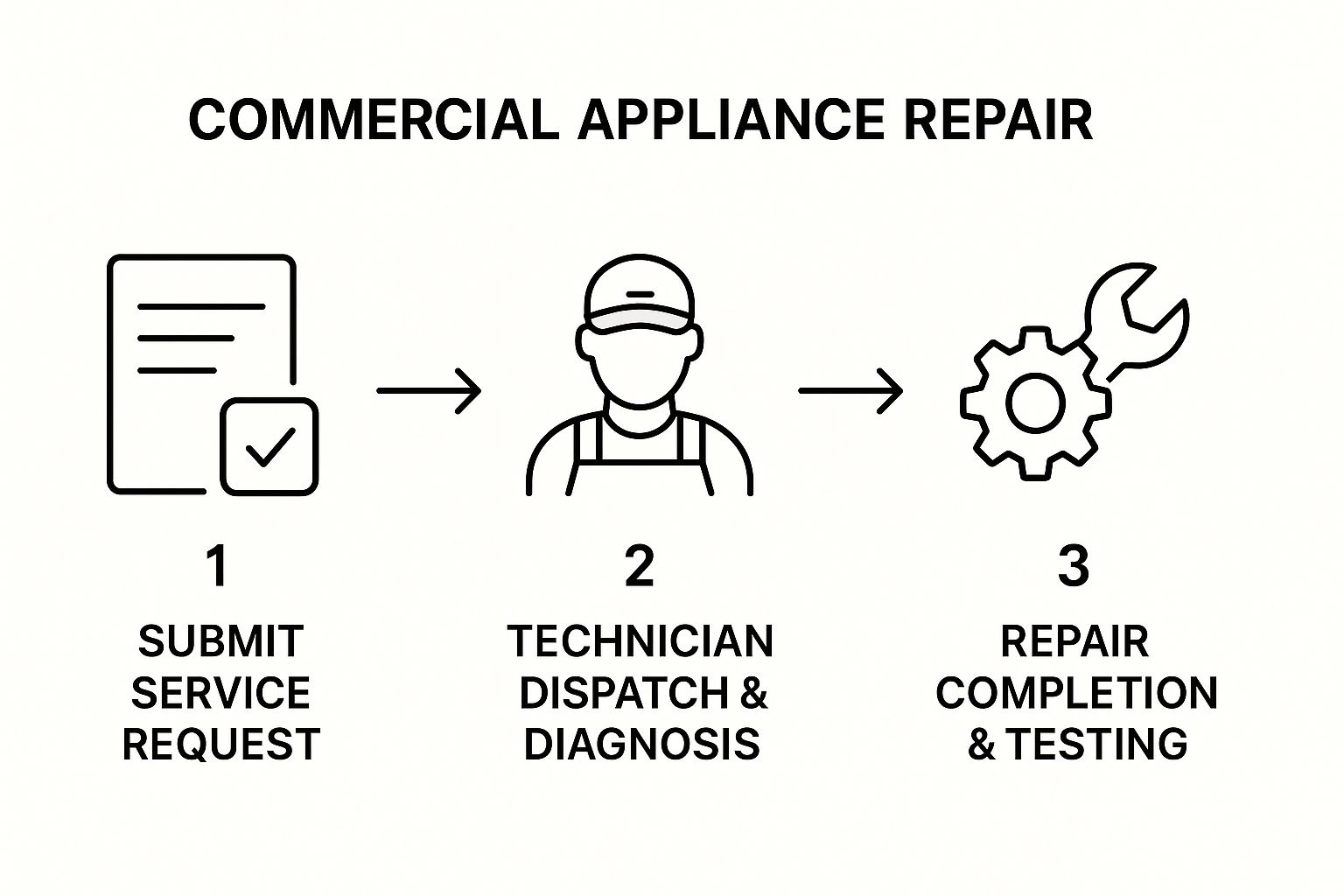
This visual really breaks down how a professional service call is designed to get you back up and running as efficiently as possible.
The Repair and Verification Process
Once the technician has identified the problem, they’ll walk you through what’s wrong and give you a clear, straightforward quote for the repair. This estimate should always break down the cost for any necessary parts and the labor involved. Total transparency at this stage is the sign of a repair partner you can trust.
After you give the green light, the real work begins. This typically involves a few key steps:
- Sourcing Parts: If the tech doesn’t have the part on their truck, they’ll order it. The best companies have solid relationships with suppliers to get parts delivered fast.
- Performing the Repair: The technician will carefully swap out the broken component, reassembling everything to meet the manufacturer’s exact specifications.
- Testing and Verification: The job isn’t done just because the part is in. They’ll run the appliance under real-world conditions to make absolutely sure it’s working perfectly again.
A professional repair service doesn’t just fix the immediate problem. They verify the solution, ensuring your equipment is reliable, safe, and ready to handle the demands of your busy kitchen.
This final testing stage is your peace of mind. It’s the confirmation that the repair was a success and you can get back to business without worrying about the same issue popping up again tomorrow.
Decoding Your Commercial Repair Invoice

The repair is done, the kitchen is back up and running, and now the invoice has arrived. After the stress of a sudden equipment failure, the last thing you need is a bill that feels like a mystery. Getting a handle on what goes into that final number helps you budget smarter and make better decisions for your business.
Think of a commercial appliance repair invoice like a mechanic’s bill for your car—it’s not just one lump sum. It’s a combination of labor, parts, and other service charges that all add up. Learning to read it confidently means you can spot fair value and avoid any unwelcome financial surprises.
This kind of clarity is more important than ever. The global market for kitchen appliance repair was valued at roughly $13 billion in 2024 and is on track to hit $22 billion by 2033. Why the boom? Modern equipment is getting more complex, making professional expertise a necessity, not a luxury. You can read more about these market trends and growth factors to see where the industry is headed.
Breaking Down the Primary Cost Factors
So, what are you actually paying for? A few key variables almost always drive the final cost of a repair job. Knowing them ahead of time lets you ask the right questions and understand the quotes you receive.
Labor Rates: This is what you pay for the technician’s time and skill, usually billed by the hour. Expect to pay a premium for emergency calls after hours or on a weekend compared to a standard weekday appointment.
Replacement Parts: The cost here can swing wildly. A simple switch or gasket might only be a few dollars, but a new compressor for your walk-in cooler or a sophisticated control board for a combi oven can easily run into the hundreds.
Appliance Complexity: It’s just common sense—fixing a simple countertop fryer will cost less than troubleshooting a massive, computer-controlled combination oven. The more intricate the machine, the more time and specialized knowledge it takes to fix.
Travel and Service Fees: Most companies charge a flat “service call” fee for the initial visit to diagnose the problem. This usually covers the technician’s travel time to your location. Often, this fee is waived or credited back if you decide to go ahead with the repair.
Understanding these variables transforms a confusing invoice into a clear, predictable financial document, allowing for better budgeting and cost control in your business operations.
When you know these components, you’re in a much better position to compare quotes and partner with a provider who offers clear, fair pricing.
Comparing Repair Costs for Common Commercial Appliances
To give you a clearer picture, it helps to see some real-world cost estimates. The price of a repair depends heavily on the specific appliance and what went wrong. A simple fix on a microwave is worlds away from a major overhaul of a walk-in freezer.
This table breaks down some typical repair cost ranges for common pieces of commercial kitchen equipment. Use it as a general guide to help you budget for potential expenses.
| Appliance Type | Common Issues | Estimated Repair Cost Range |
|---|---|---|
| Commercial Refrigerator | Compressor failure, refrigerant leak, faulty thermostat | $300 – $1,500+ |
| Ice Machine | Water pump failure, clogged lines, sensor issues | $250 – $900 |
| Commercial Oven | Broken heating element, faulty ignitor, thermostat problems | $200 – $1,200 |
| Fryer | Malfunctioning thermostat, pilot light won’t stay lit | $150 – $700 |
| Dishwasher | Clogged spray arms, heating element failure, drain pump issues | $250 – $800 |
Keep in mind these are just ballpark figures. The final cost will always depend on the technician’s labor rate, the price of specific parts, and the complexity of the repair.
Emergency Calls Versus Scheduled Maintenance
One of the biggest things that can inflate your repair bill is urgency. A desperate call for a technician on a Saturday night will almost always cost significantly more than a planned service visit during regular business hours.
That higher rate covers the immediate dispatch and the disruption to a technician’s standard schedule. This is precisely why a good preventative maintenance plan is one of the smartest investments you can make. It helps you catch problems before they become catastrophes, letting you schedule repairs on your own time and avoid the premium price tag—and crippling downtime—of a full-blown emergency.
Proactive Maintenance Versus Reactive Repairs

When it comes to your kitchen equipment, you have two choices. You can wait for a breakdown and then scramble to fix it, or you can work to stop it from breaking in the first place. This is the fundamental difference between reactive repairs and proactive maintenance.
It’s a bit like owning a car. A reactive repair is the frantic call to a tow truck after a flat tire on the highway—an unexpected, stressful, and often expensive emergency. Proactive maintenance is that scheduled oil change that keeps the engine humming along for years. It’s a planned investment, not a sudden crisis.
The Value of a Proactive Strategy
A proactive strategy, built around professional commercial appliance repair services, isn’t just about dodging breakdowns. It’s about protecting your investment and getting the most out of your expensive equipment. A solid maintenance plan can significantly extend the lifespan of your assets, making sure every dollar you spent was worth it.
This approach shifts your focus from crisis management to strategic asset protection. You end up forming a partnership with your repair service to keep your kitchen running at peak performance. For a closer look at what this involves, feel free to check out our guide on commercial kitchen equipment maintenance.
Proactive maintenance isn’t just another expense; it’s an investment in your restaurant’s stability. It helps you avoid surprise costs, keeps energy bills down, and prevents the lost revenue that comes with unexpected downtime.
What a Maintenance Plan Includes
A proper preventative maintenance plan is far more than a quick look-over. It’s a detailed, systematic process designed to spot small issues before they snowball into catastrophic failures.
A typical plan often includes:
- Routine Inspections: A technician will methodically check all critical components for any signs of wear, strain, or potential failure.
- Thorough Cleaning: This goes way beyond your daily wipe-downs. We’re talking deep cleaning of coils, filters, and internal parts that are crucial for performance.
- Component Calibration: Experts make sure thermostats, pressure gauges, and sensors are giving accurate readings, which improves food quality and energy efficiency.
- Lubrication and Adjustments: All moving parts are properly lubricated to reduce friction and stop them from wearing out too soon.
This forward-thinking approach is becoming the new standard. The global refrigerator repair service market, for example, is expected to hit around $15 billion by 2025. That growth is happening because businesses are choosing to extend the life of their appliances through smart maintenance and repairs, moving toward a more sustainable and cost-effective model.
How to Choose the Right Repair Partner
Picking a company for your repairing restaurant equipment isn’t just about getting a quick fix. It’s one of the most critical decisions you’ll make for your business. You’re not just hiring a technician; you’re bringing on a long-term partner who understands just how much is riding on your equipment running smoothly.
Think of them as a vital part of your support staff. The right team acts as an extension of your own, safeguarding your investments and helping you sidestep those catastrophic failures that can shut you down. Get this choice right, and you’re buying yourself minimal downtime and maximum peace of mind.
Key Qualities of a Top-Tier Service
When you start looking at different companies, don’t let price be your only guide. You need to dig deeper and look for a provider that lives and breathes expertise, responsiveness, and total transparency. These are the pillars of a service relationship you can actually count on.
Before you sign on the dotted line, make sure you’ve checked these boxes:
- Proper Certifications and Insurance: Are their techs actually certified to work on commercial-grade gear and handle refrigerants? Just as important, does the company carry enough liability insurance to protect your business if something goes wrong?
- Brand-Specific Experience: It’s one thing to fix a generic freezer, but it’s another to know the ins and outs of your True walk-in or Vulcan range. A technician who already knows your equipment will find and fix the problem in half the time.
- Guaranteed Response Times: In the food business, waiting days for a repair is a non-starter. Look for a service that puts their emergency response times in writing, especially for game-changing equipment like refrigeration.
- Transparent Pricing: A pro will give you a clear, itemized quote before they even pick up a tool. You should never have to worry about hidden fees or sticker shock when the final bill arrives.
Choosing a repair partner is like picking a co-pilot for your business. Their reliability, expertise, and speed directly impact your ability to navigate challenges and stay profitable.
Critical Questions to Ask
To cut through the sales pitches, go into the conversation armed with a few key questions. How they answer will tell you everything you need to know about their professionalism and whether they’re the right fit.
- What are your standard and emergency service hours?
- Do you offer any preventative maintenance plans to help us avoid future breakdowns?
- What kind of warranty do you provide on your parts and labor?
- Can you give me a few references from other local restaurants you work with?
Finding the right team is everything. A great partner doesn’t just fix what’s broken today—they help you build a more resilient and successful operation for tomorrow.
Frequently Asked Questions About Appliance Repair
When a mission-critical piece of kitchen equipment goes down, you’ve got questions, and you need answers fast. Making the right call under pressure is tough, but understanding the basics of commercial appliance repair services can make all the difference. Let’s walk through some of the most common questions we get from folks in the foodservice business.
How Fast Should a Tech Show Up?
When your walk-in freezer dies, time is money—literally. You’re losing product by the minute. For a true kitchen emergency like that, a quality repair company should be on-site within 2 to 4 hours. That’s the industry benchmark for an emergency response.
Many companies also offer service contracts that put you at the front of the line. If you’re a contract client, you get priority dispatch, which is a lifesaver during a busy dinner rush. Before you sign with anyone, get their guaranteed emergency response time in writing. It’s a non-negotiable detail that could save your inventory.
Should I Repair This Thing or Just Replace It?
This is the big question, isn’t it? It usually boils down to a bit of simple math. We often talk about the “50% rule” in the industry. If a repair is going to cost more than half the price of a brand-new, comparable appliance, it’s probably time to start shopping for a replacement.
But money isn’t the only thing to think about. You also have to weigh a few other factors:
- Age & History: Is this the first time this machine has broken down, or does it feel like you’re calling a technician every other month?
- Efficiency: A new unit might cost more upfront, but it could slash your monthly utility bills, saving you money in the long run.
- Parts: For older or more obscure models, just finding the right parts can be a nightmare, and they often come with a premium price tag.
A good, honest technician won’t just give you a quote; they’ll help you think through these points so you can make a decision that’s best for your bottom line.
What Kind of Warranty Can I Expect on a Repair?
Any reputable repair service will stand behind their work, period. You should always look for a company that offers a minimum 30 to 90-day warranty that covers both the new parts and the labor.
This is your safety net. It means if the exact same problem crops up again within that window, they’ll come back and fix it without charging you for another service call. Make sure you get the warranty terms in writing before you give them the green light to start the work.
What Maintenance Can My Own Staff Handle?
Your team is your first line of defense in the war against equipment failure. While you should leave the heavy-duty electrical and mechanical work to the pros, simple, daily habits can dramatically extend the life of your appliances.
Handing your staff a simple maintenance checklist is one of the most powerful things you can do to cut down on emergency calls and protect your investment.
Think about tasks like cleaning the air filters on your refrigerators, wiping down the door gaskets on your coolers, or clearing out the gunk from oven burners. These small, consistent actions are incredibly effective and work hand-in-hand with professional preventative maintenance to keep your kitchen humming.
At Ice Age Refrigeration, our goal is to give you clear answers and dependable repairs that keep your business running. If you need an expert commercial appliance repair team in the Phoenix Metro Area, visit us at https://lightsteelblue-crane-848111.hostingersite.com to get a technician on the way.